- Jay Parsons' Rental Housing Economics
- Posts
- April Multifamily Update: A Ho-Hum Start to the Leasing Season
April Multifamily Update: A Ho-Hum Start to the Leasing Season
If you thought the market would tank due to weak job numbers, you were wrong. And if you expected a strong rebound, you were wrong, too.

Jay Parsons
April 24, 2026
Today’s edition sponsored by: JPI, Authentic, X-Caliber, Robora, Authentic and Berkadia’s “Inside the Deal” CRE podcast.
Spring Leasing Season is Off to A Ho-Hum Start
Going into the spring leasing season last month, I wrote this: “Spring is always critical in the apartment business, of course. But it kinda feels even MORE important here in 2026.”
So now that we’re in the heart of the spring leasing season, how does it look so far?
Well, the word “ho-hum” comes to mind.
It’s not bad by any means. If you worried the tepid job market would freeze up apartment demand, that hasn’t happened. But if you hoped to see a big spring rebound, that didn’t happen, either. It’s … okay.
Apartment demand has been very solid. Just not enough to put a big dent in vacancy rates elevated by the massive 2023-25 supply wave. Rents did increase in March. Just not as much as we typically see this time of year. And that’s largely because vacancy is still elevated, limiting pricing power.
As my friend Grant Montgomery at CoStar wrote: “The modest gains in March point to a more gradual early‑season recovery than is typically observed as supply conditions remain a constraint on rent growth nationally.” He’s right. That’s the story.
Let’s break down the numbers across the key metrics:


Supply: The Drop-Off is Here
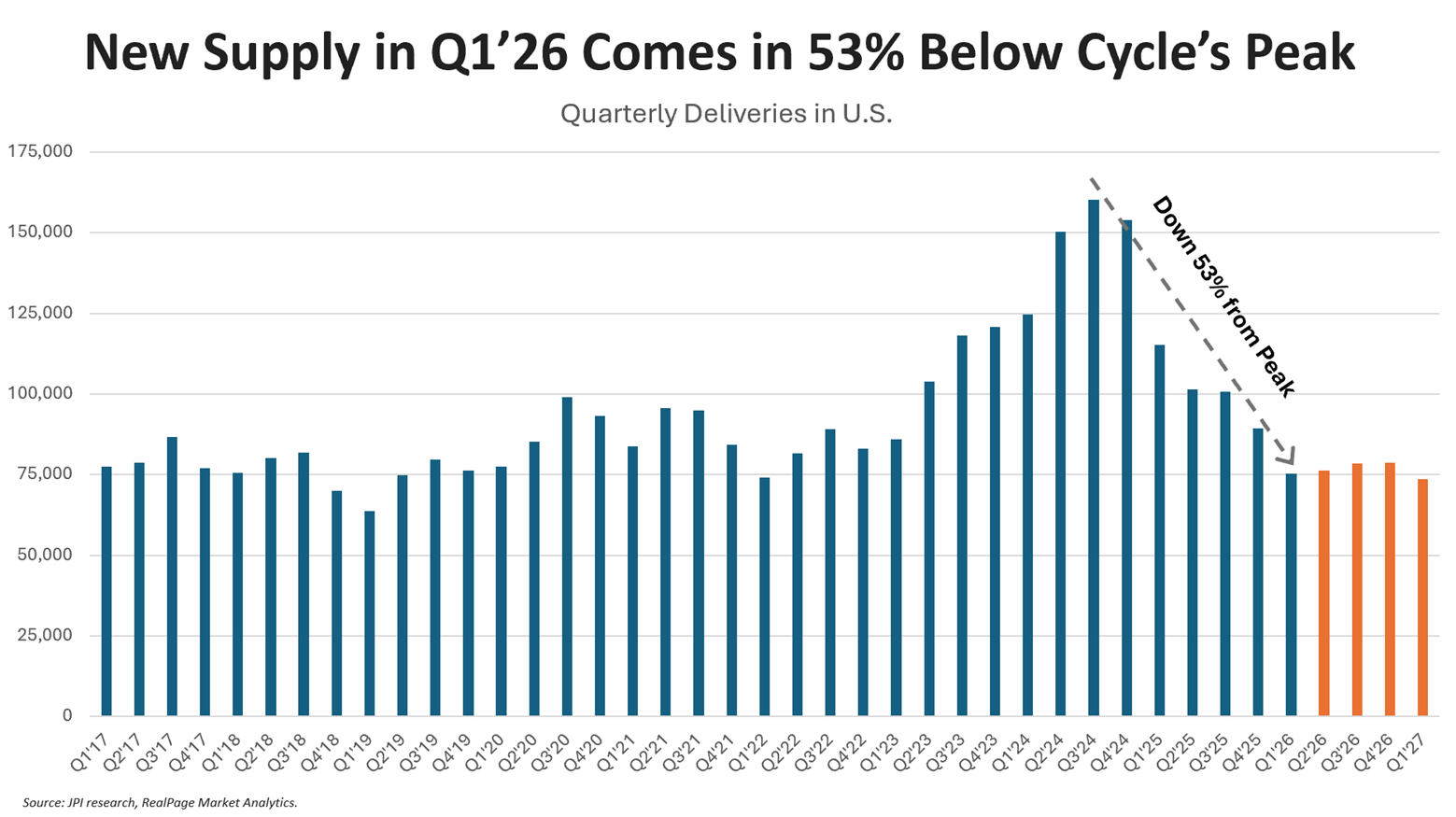
As expected, supply plunged in Q1 2026. (Finally, right?) Q1 2026 came in as one of the lowest supplied quarters since 2018 with 75k units completing, down 53% from the peak set back in Q3 2024. That’s the first time in four year that quarterly deliveries came in below 80k units. So supply isn’t totally evaporating, but it’s dropped off significantly. And we should see similar numbers through 2026.
That drop is basically universal, extending not just to the Sun Belt but even to lower-supplied markets in the Midwest.
Demand: Still Cooking, Even if at a Lower Temperature, as Flight to Quality Persists
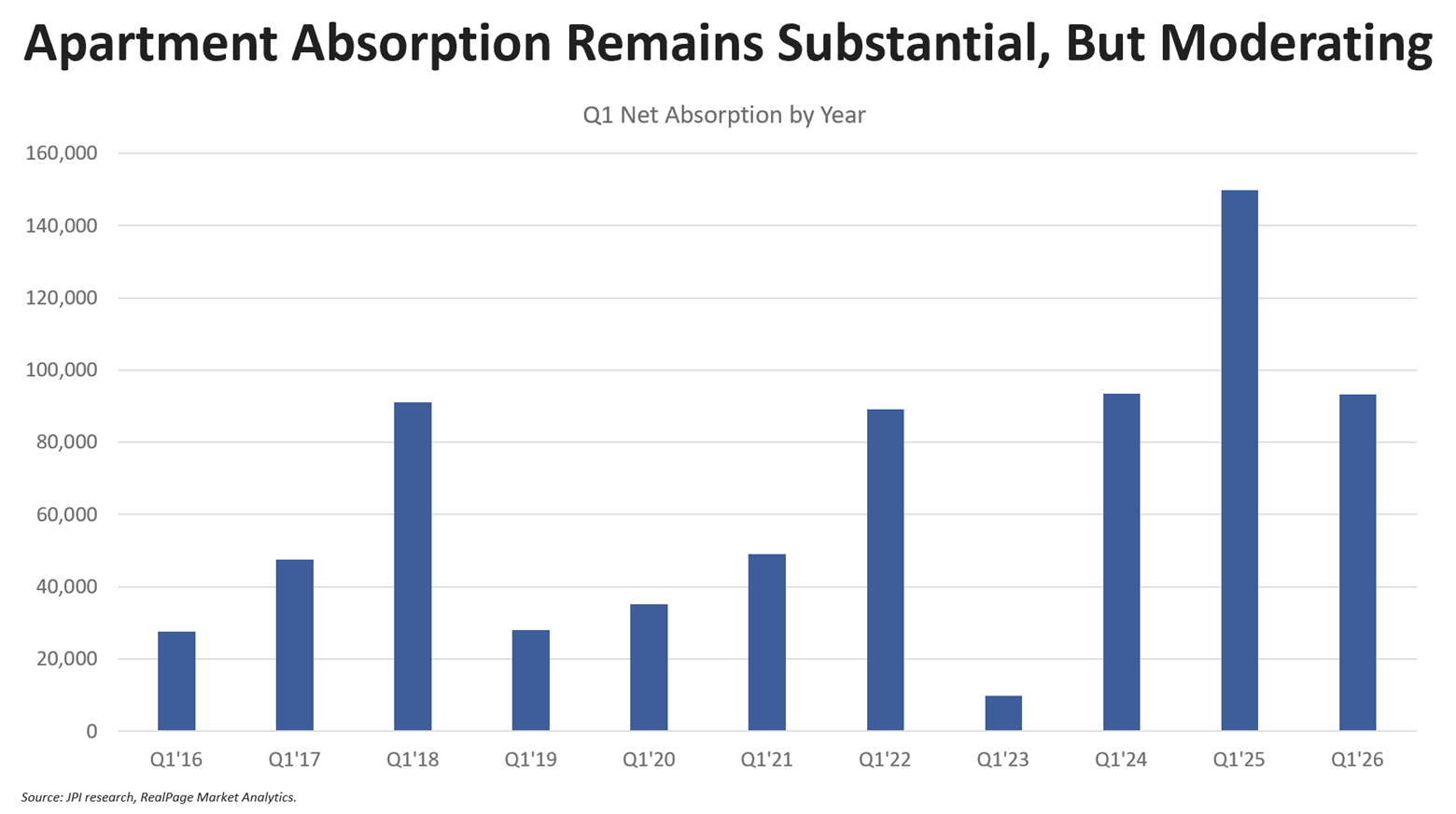
Pick your favored data provider and take their Q1 absorption number. If you looked at Q1 in a vacuum, you’d say that’s a good absorption number, even if down from the recent peaks. But obviously we aren’t operating in a vacuum. And solid numbers look unspectacular when you have a big hole to dig out of … that hole being the supply overhang from 2023-25 that drove up vacancy rates.
As Cushman & Wakefield recently reported (using CoStar data): “Multifamily demand normalized in the first quarter, consistent with typical seasonality and a softer labor market backdrop. Net absorption totaled 65,200 units, down 34% year-over-year. Despite the slowdown, demand was broadly in line with historical first-quarter averages.”
So most apartment operators probably wanted a stronger start to 2026, enough to put a bigger dent in vacancy and regain some pricing power. That didn’t really materialize. As Radix’s Jay Denton writes, occupancy “displayed minimal growth since the beginning of the year rather than the typical seasonal increase.”
But the occupancy story is very nuanced, fueled by a continued “flight to quality” effect. As Cushman points out: “Renters continue to favor newer, high-quality product. Class A vacancy declined roughly 80 bps over the past year as renters trade up in quality, while Class B and C vacancy increased by a similar magnitude.”
We should also point this out: Given all the emerging demand headwinds, you might call the 2026-to-date absorption and occupancy numbers an upside surprise underscoring the sector’s resilience. Apartment absorption typically depends on job growth (even if the correlations are very messy.). And even absent much job growth in most markets – and all the worries about the impacts of AI, the Iran conflict, low consumer confidence, etc. – we still saw very solid absorption.
And where’s that demand going? Well the usual suspects dominate the leaderboard – Dallas, Phoenix, Atlanta, Charlotte, Austin, Orlando, etc., (though Houston was a notable exception of late, more on that below) but outside the Sun Belt we also have big numbers in New York, Northern New Jersey, Columbus, and Philadelphia.

Concessions and Rent: It’s Still a Renter’s Market
With improving affordability (wage growth topping rent growth for 38+ straight months) and ample options (on the heels of the largest supply wave in nearly a half-century), apartment renters retain the upper hand.
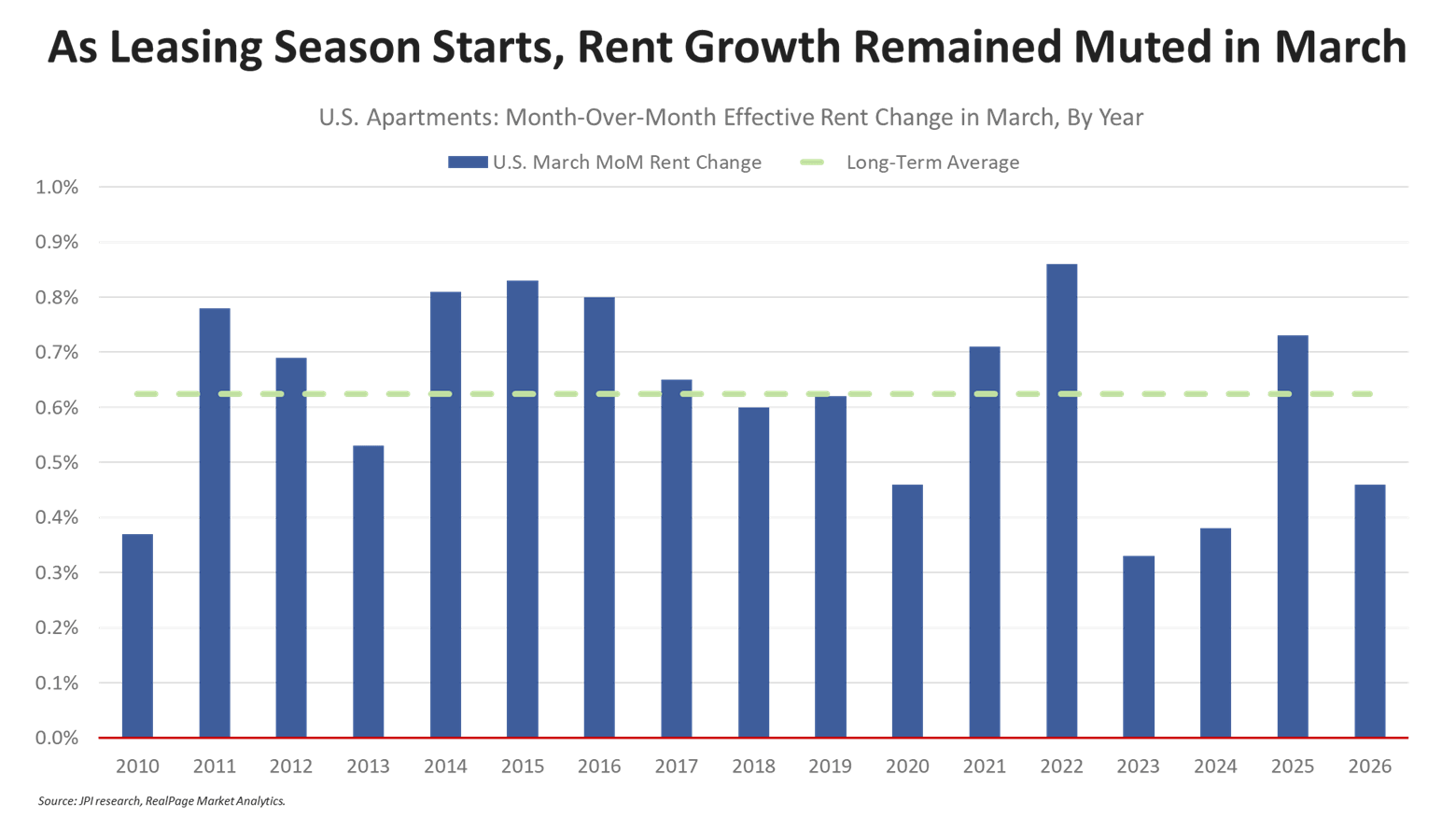
That means operators remain in ever-extending occupancy build-up mode – pushing rents more modestly than usual for March. Concessions remain abundant, with no sign of a pullback yet.
Rents did indeed increase in March, but not much – just 0.46% compared to February. But that’s almost 20 bps below the long-term norm for March. Year-over-year rent change remained even weaker at -0.7%, according to RealPage, or +0.4% according to CoStar.
Regional and Local Storylines
Regionally, the storylines haven’t changed much. Rent trends are improving across most of the country, but at a very gradual pace.
San Francisco remains atop the leaderboard with rents up 9% year-over-year, followed by next-door San Jose at 5%. On the other side of the country, one market that has snuck up the leaderboard is Virginia Beach, now topping 4%. New York, Chicago, Milwaukee, Cleveland also ranked high.
On the flip side, the usual suspects still pull up the rear: Austin, Denver, San Antonio and Phoenix. And then they’re joined by Tampa, which has lost considerable momentum over the past year. Rents in Tampa dropped 5.6% year over year. That’s a massive change from just one year ago, when Tampa ranked among the few major Sun Belt markets with positive rent growth. That traces to weakening demand and occupancy losses, particularly in the second half of last year.
Another market to keep an eye on is Houston. This one puzzles me, and candidly I expected to see better numbers by now. Not a ton of supply there relative to other Sun Belt markets, plus the latest Census data shows Houston was the fastest-growing metro areas for population growth in 2025; and yet, apartment absorption really dropped way down over the same time period. So that means population growth isn’t translating to household formation – at least not yet, and maybe more immigration impacts in certain parts of the market. That impact isn’t just fewer immigrants, but downstream impact on local businesses, as well. (I still think Houston could turn the corner given strong demand drivers plus moderate supply. Just not sure when that happens.) Yardi also noted Houston was one of three metros (along with Tampa and D.C. showing material declines in occupancy over the past year.)

Here’s the bottom line
We’re in the heart of the spring leasing season now, and the balance of power is still very much with the renters. They’ve got more options thanks to all this supply, and that means it’s still a competitive leasing environment in most of the country.
If you thought we’d see the balance of power shift by now due to falling supply, remember this: Deliveries are down in 2026, yes, but that massive supply wave from 2023-25 still has to lease up and stabilize before we can see vacancy rates normalize. And that likely has to happen before we see operators regain pricing power.
Other Highlights
Radix’s past two weekly updates report lease signings per week fell by 0.8 year-over-year.
RealPage deputy chief economist Arben Skivjani writes about the impact of slowing economic indicators on the apartment outlook.
CoStar’s Apartments.com highlights “10 Cities Where AI Is Shaping the Rental Landscape.”
Yardi’s data shows New York City topping San Francisco on the rent growth leaderboard (while others have San Francisco on top), followed by Chicago in third place.
RealPage’s rent growth leaderboard now puts Virginia Beach in the top 3 — behind San Francisco and San Jose, while just ahead of New York and Chicago.
Apartment List puts Virginia Beach in the No. 1 spot for its rent growth leaderboard, ahead of the Bay Area. Their top five also includes Rochester and Honolulu.
Cushman & Wakefield released its AI Impact Barometer estimating the impact of AI on commercial real estate and the economy.
— My Latest Posts on LinkedIn —
Here are some recent posts if you missed them:
If you just trended 3.5% annualized rent growth from pre-COVID to today, you’d land right at today’s average effective rents in the Sun Belt and Mountain markets.
There’s suddenly very little pricing premium for apartments built in the 2020s compared to those built in the 2010s.
Apartment supply is falling especially hard in urban submarkets.
A former U.S. solicitor general published a paper concluding that the ROAD to Housing Act’s investor bans are "constitutionally flawed thrice over."
Aimco founder and multifamily legend Terry Considine is still at it.
The latest NMHC Top 50 rankings show that multifamily ownership remains incredibly fragmented.
Peak apartment completions are now in the rearview mirror.
Early numbers on the spring leasing season are ho-hum: not bad, not great.
The build-to-rent construction pipeline is shut down thanks to potential legislation.
Every Midwest apartment investor should have this slide in their decks.
Camden is promoting its next generation of homegrown leadership into the C-suite.
Senator Warren is expanding her sights to apartments and manufactured housing.
Could the ROAD to Housing Act die on the vine? The latest news suggests it’s possible.
Rental affordability is a deeply bifurcated issue of haves and have nots, as the latest Harvard report on rental housing shows.
Who remembers ranch apartments? Equity Residential used to have a lot of them.
Most policymakers (and most Americans, too) probably have no idea that the U.S. LOST more than 1 million single-family rental homes over the past decade.
— Now Spinning on The Rent Roll Podcast —
For 2025, The Rent Roll with Jay Parsons podcast ranked in Spotify’s top 2% of podcasts for minutes played and in the top 1% for most shared shows. Additionally, The Rent Roll continues to frequently rank on Apple’s charts for investing-themed podcasts, and was recently ranked as the third-best podcast in all commercial real estate (and #1 in housing) by the readers of CRE Daily!
Thank you to everyone who’s made The Rent Roll part of your weekly routine! New episodes are released every Thursday morning.
Episode 81: Finding Under-Loved Markets with Bonaventure’s Dwight Dunton
Episode 80: Terry Considine Isn’t Done: The Multifamily Legend’s Next Act with Big 4’s Terry Considine
Episode 79: Q2 Multifamily Update & Outlook with Cushman & Wakefield’s Sam Tenenbaum
Episode 78: The Bizarre Push to Eliminate BTR with Quinn Residences’ Richard Ross and Up for Growth’s Mike Kingsella
Episode 77: Sub-Institutional Multifamily Update, with Adaptive Realty’s Moses Kagan and ReSeed Partners’ Rhett Bennett
Episode 76: Affordable Housing Isn’t What You Think with Dominium’s Nick Andersen
Episode 75: The Evolution of Equity Residential with EQR’s Mark Parrell
Episode 74: Inside Multifamily’s Biggest Family Business with Morgan Properties’ Jason Morgan
Episode 73: Takeaways from SFR REIT Calls + the Outlook for Rental Housing Investment with Principal’s Rich Hill

